Top 5 Shoulder Rehab Exercises for Athletes with Rotator Cuff Injuries
Rotator cuff injuries are one of the most common shoulder problems in athletes. Whether you’ve had surgery or not, evidence shows that rehab exercise is the cornerstone of recovery. The goal? Restore strength, stability, and control, so you can return safely to sport.
Here are the top 5 evidence-based rehab exercises for athletes with rotator cuff injuries.
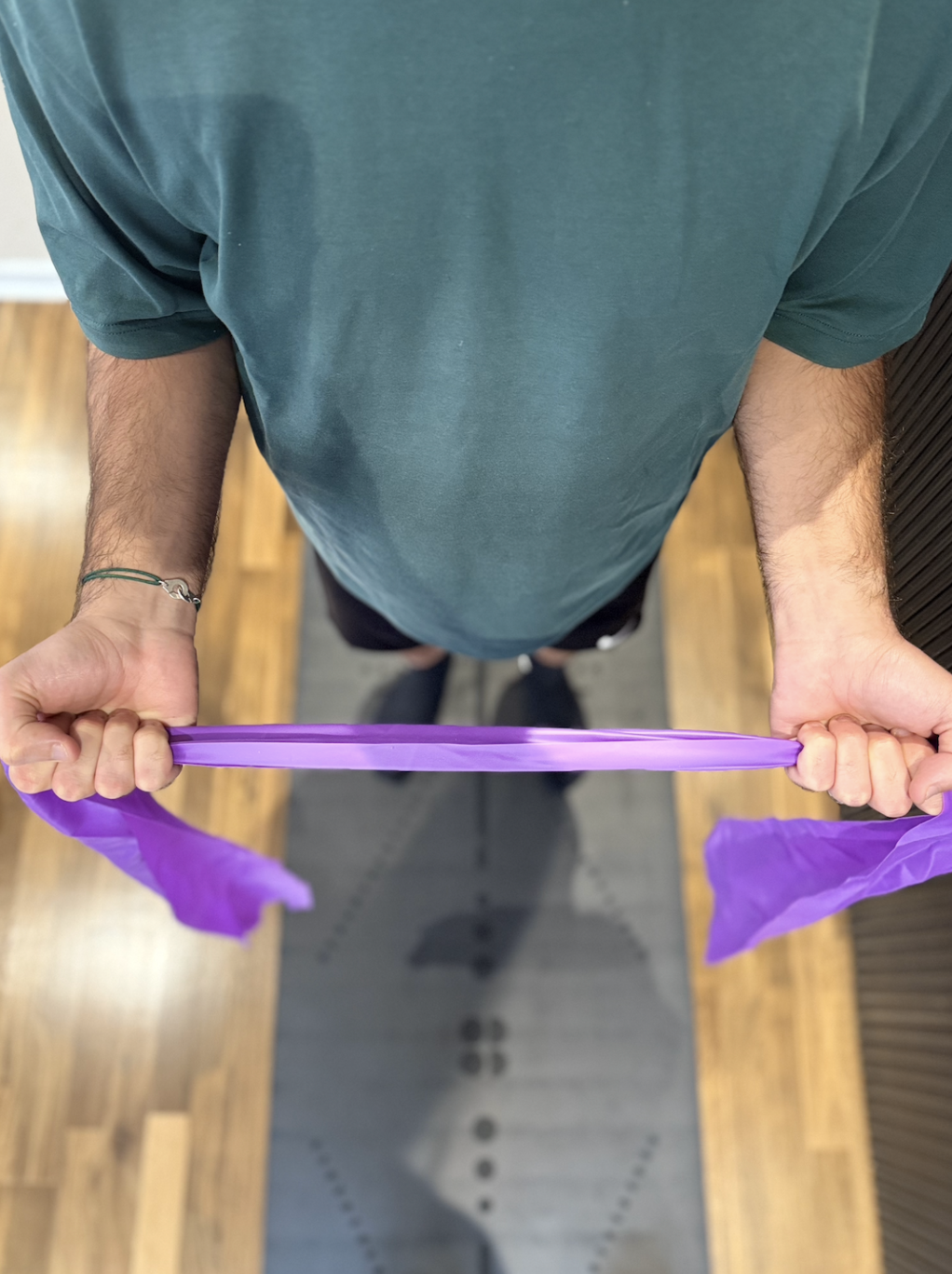
1. External Rotation with Band (at 0° or 90°)
Why: External rotators (infraspinatus, teres minor) are often weakened in cuff injuries. Restoring their strength protects the shoulder during throwing, lifting, or overhead movements.
How:
Attach a resistance band to a stable anchor.
Keep your elbow bent at 90°, rotate the forearm outward while keeping the elbow close to the body.
Progression: perform in 90° abduction to mimic sport-specific loads.
2. Scaption with Light Weights
Why: Lifting in the scapular plane (about 30° forward of the body) activates the supraspinatus and deltoid in a safe, functional arc.
How:
Hold light dumbbells.
Raise arms to shoulder height in a “V” shape (thumbs pointing slightly up).
Avoid shrugging shoulders.
3. Prone Y, T, W Exercises
Why: The rotator cuff doesn’t work alone — the scapula must stabilise effectively. These exercises target the lower and middle trapezius and rhomboids for overhead control.
How:
Lie face down on a bench or Swiss ball.
Raise arms into a Y (overhead), T (out to the side), and W (bent elbows).
Focus on control, not speed.
4. Serratus Punch / Wall Slide
Why: The serratus anterior helps prevent scapular winging and supports smooth upward rotation during overhead motion.
How:
Perform punches lying on your back with a weight or band, reaching towards the ceiling.
Or slide arms up a wall while keeping ribs down and core engaged.
5. Closed-Chain Weight Bearing (Quadruped or Wall Push-Up Plus)
Why: Puts the shoulder in a safe, loaded position to train co-contraction of the rotator cuff and scapular stabilisers.
How:
Start in quadruped (hands under shoulders, knees under hips).
Gently shift weight side-to-side or perform push-up plus (extra reach at the top).
Progress to wall push-ups or plank variations.
👉 Evidence: Closed-chain drills improve neuromuscular control and dynamic stability.
Key Principles for Athletes
Quality > quantity → form and control matter more than load.
Pain-free range → mild fatigue is okay, sharp pain is not.
Progressive overload → increase resistance gradually, not overnight.
Don’t forget the kinetic chain → train the core and hips too; they reduce shoulder load in sport.
Rotator cuff rehab isn’t just about the shoulder, it’s about restoring a whole chain of movement. These 5 evidence-based exercises build the foundation for safe return to throwing, lifting, or overhead sport.
With physiotherapy guidance and structured progression, you can protect your cuff and perform stronger than ever.
✨ Recovering from a rotator cuff injury? Book your session with our sports physiotherapists at Renard Clinic and get a tailored, evidence-based rehab plan.