Manual Tissue Rolling vs Lymphatic Drainage: What’s the Difference?
If you’ve ever researched recovery after surgery or scar care, you may have come across two techniques: manual tissue rolling (palpé-roulé) and lymphatic drainage (MLD). While both are gentle manual therapies, they serve different purposes and act on the body in distinct ways.
Here’s what you need to know.
What Is Manual Tissue Rolling (Palpé-Roulé)?
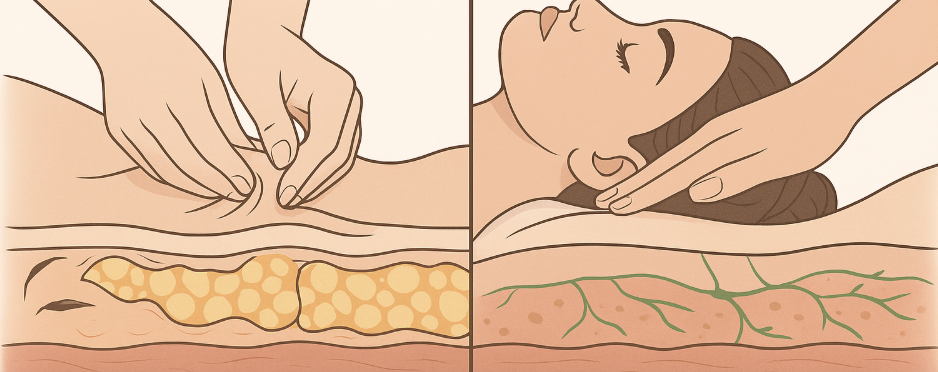
A French technique where the skin and tissue are gently pinched and rolled between the fingers.
Targets skin, fascia, and scar tissue.
Used to:
Improve scar flexibility
Release adhesions
Stimulate blood flow
Reduce tightness or fibrosis
👉 Often applied in scar management, post-surgical care, sports rehab, and aesthetics (e.g., cellulite treatments).
What Is Manual Lymphatic Drainage (MLD)?
A gentle, rhythmic massage technique that follows lymphatic pathways.
Targets the lymphatic system to help drain excess fluid and waste.
Used to:
Reduce swelling and edema
Support healing after surgery
Manage lymphedema or chronic swelling
Improve comfort and tissue health
👉 Considered the gold standard in lymphedema care, and widely recommended after breast, pelvic, or cosmetic surgery.
Key Differences
AspectManual Tissue RollingLymphatic Drainage (MLD)TargetSkin, fascia, connective tissueLymphatic vessels & nodesPressurePinching/rolling, more mechanicalVery light, rhythmic strokesGoalImprove scar pliability, release adhesions, stimulate blood flowReduce swelling, support lymph flow, prevent fibrosisMain UsesScar care, fibrosis, aesthetics, fascial releaseLymphedema, post-surgery swelling, chronic edema
Can They Be Combined?
Yes ✅. In fact, many physiotherapists use both techniques as part of a comprehensive recovery program:
Early phase → focus on lymphatic drainage to reduce swelling.
Later phase → add tissue rolling to mobilise scars and prevent stiffness.
What the Evidence Says
MLD is strongly supported in lymphedema and post-surgical recovery protocols.
Tissue rolling has growing evidence for scar management and fascial mobility.
The most effective care often combines both, alongside compression and exercise.
Manual tissue rolling and lymphatic drainage may look similar, but they target different systems. One works on scars and fascia, the other on fluid and lymph. Together, they provide powerful, evidence-based support for healing, comfort, and recovery.
✨ Not sure which technique is right for you? Book a consultation with our physiotherapists at Renard Clinic for a tailored recovery program that combines the best of both approaches.